Presentation Tips
10 min read
•September 16, 2026
Startup Pitch Deck vs Investor Presentation: What's the Difference?
Learn the difference between a startup pitch deck and investor presentation, including their purpose, structure, slides, audience, data, and when to use each.
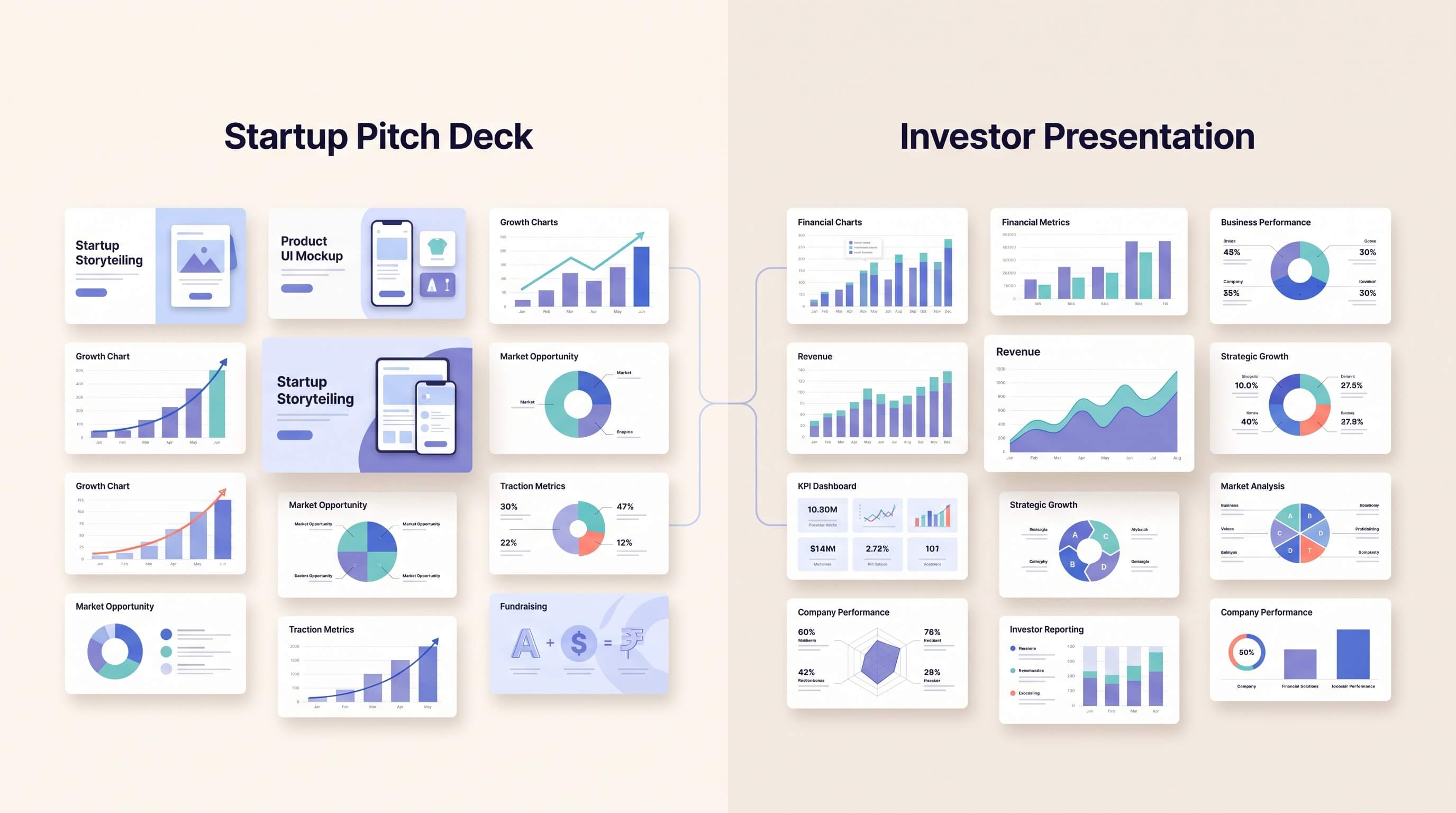
<p>The terms <strong>startup pitch deck</strong> and <strong>investor presentation</strong> are often used interchangeably, but they do not always mean exactly the same thing.</p>
<p>Both are designed to communicate a business opportunity to investors or other stakeholders. However, they can differ in purpose, audience, level of detail, and how the information is presented.</p>
<p>Understanding the difference can help founders choose the right presentation format for a fundraising meeting, investor introduction, demo day, or follow-up discussion.</p>
<p>In simple terms, a <strong>startup pitch deck</strong> is usually a concise presentation built around a startup's story and investment opportunity, while an <strong>investor presentation</strong> can refer to a broader range of presentations used to communicate financial, strategic, or business information to investors.</p>
<p>Let's break down the difference.</p>
<h2>What Is a Startup Pitch Deck?</h2>
<p>A <strong>startup pitch deck</strong> is a presentation created to communicate a startup's business opportunity, typically to potential investors.</p>
<p>It usually tells a structured story:</p>
<p><strong>Problem → Solution → Market → Business Model → Traction → Team → Funding Ask</strong></p>
<p>The goal is to give an investor enough context to understand the company and determine whether they want to continue the conversation.</p>
<p>A startup pitch deck commonly includes:</p>
<ul>
<li>Company introduction</li>
<li>Problem</li>
<li>Solution</li>
<li>Product</li>
<li>Market opportunity</li>
<li>Business model</li>
<li>Traction</li>
<li>Competition</li>
<li>Competitive advantage</li>
<li>Go-to-market strategy</li>
<li>Team</li>
<li>Financial information</li>
<li>Funding requirements</li>
</ul>
<p>The exact structure can change depending on the startup's stage and fundraising situation.</p>
<p>An early-stage startup with no revenue, for example, may emphasize the problem, product, market, and early validation.</p>
<p>A startup with significant revenue may spend more time on traction, unit economics, growth, and financial performance.</p>
<h2>What Is an Investor Presentation?</h2>
<p>An <strong>investor presentation</strong> is a broader term for a presentation created specifically for investors or shareholders.</p>
<p>It can include a startup pitch deck, but it can also refer to presentations used by established companies.</p>
<p>For example, an investor presentation might cover:</p>
<ul>
<li>Quarterly financial performance</li>
<li>Annual results</li>
<li>Business strategy</li>
<li>Growth plans</li>
<li>Market conditions</li>
<li>Product updates</li>
<li>Corporate strategy</li>
<li>Mergers and acquisitions</li>
<li>Capital allocation</li>
<li>Investor events</li>
</ul>
<p>This means an investor presentation does not necessarily have to be a fundraising pitch.</p>
<p>A public company, for example, may publish an investor presentation explaining its latest financial results and strategic direction.</p>
<p>A startup raising its first funding round, on the other hand, may use a startup pitch deck as its primary investor presentation.</p>
<h2>Startup Pitch Deck vs Investor Presentation</h2>
<p>The easiest way to understand the distinction is to think about <strong>scope</strong>.</p>
<p>A startup pitch deck is generally a specific type of investor-facing presentation.</p>
<p>An investor presentation is a broader category that can cover many different investor communication needs.</p>
<table>
<thead>
<tr>
<th>Aspect</th>
<th>Startup Pitch Deck</th>
<th>Investor Presentation</th>
</tr>
</thead>
<tbody>
<tr>
<td>Primary purpose</td>
<td>Present a startup and investment opportunity</td>
<td>Communicate business, financial, or investment information</td>
</tr>
<tr>
<td>Typical audience</td>
<td>Potential investors, VCs, angels</td>
<td>Investors, shareholders, analysts, financial stakeholders</td>
</tr>
<tr>
<td>Storytelling</td>
<td>Usually highly narrative</td>
<td>Can be narrative or data-driven</td>
</tr>
<tr>
<td>Business stage</td>
<td>Commonly startups and growth companies</td>
<td>Startups, private companies, and public companies</td>
</tr>
<tr>
<td>Main focus</td>
<td>Problem, solution, market, traction, opportunity</td>
<td>Performance, strategy, financials, growth, or fundraising</td>
</tr>
<tr>
<td>Length</td>
<td>Often concise</td>
<td>Can vary considerably</td>
</tr>
<tr>
<td>Funding ask</td>
<td>Common</td>
<td>Optional</td>
</tr>
<tr>
<td>Product explanation</td>
<td>Usually important</td>
<td>Depends on the purpose</td>
</tr>
</tbody>
</table>
<p>The two formats can overlap significantly.</p>
<p>A startup pitch deck used during a fundraising process can effectively function as an investor presentation.</p>
<p>However, not every investor presentation is a startup pitch deck.</p>
<h2>When Should You Use a Startup Pitch Deck?</h2>
<p>A startup pitch deck is particularly useful when you need to introduce your company to someone who does not know the business yet.</p>
<p>Common situations include:</p>
<h3>Fundraising Meetings</h3>
<p>When approaching angel investors or venture capital firms, your pitch deck provides a structured overview of the opportunity.</p>
<p>The presentation should help investors quickly understand:</p>
<ul>
<li>What problem you solve</li>
<li>Who your customers are</li>
<li>What you have built</li>
<li>How large the market is</li>
<li>How you make money</li>
<li>What traction you have</li>
<li>How much you are raising</li>
</ul>
<h3>Demo Days</h3>
<p>Startup accelerators and incubators often give founders only a few minutes to present.</p>
<p>In this situation, the pitch deck needs to communicate the core story quickly.</p>
<p>The slides should support the spoken presentation rather than becoming a document that the audience has to read independently.</p>
<h3>Investor Introductions</h3>
<p>A concise startup pitch deck can also be useful when sending an initial presentation to a potential investor.</p>
<p>In this case, the deck should provide enough information to create context without attempting to answer every possible question.</p>
<h3>Fundraising Follow-Ups</h3>
<p>After an initial meeting, investors may ask for additional information.</p>
<p>The original pitch deck can become the foundation for a more detailed investor presentation containing additional metrics, financial information, or business details.</p>
<h2>When Should You Use an Investor Presentation?</h2>
<p>An investor presentation is more appropriate when the purpose goes beyond introducing a startup.</p>
<p>For example, an established company may use an investor presentation to explain its latest financial performance.</p>
<p>A presentation might include:</p>
<ul>
<li>Revenue growth</li>
<li>Profitability</li>
<li>Cash flow</li>
<li>Business segments</li>
<li>Market expansion</li>
<li>Strategic initiatives</li>
<li>Capital expenditure</li>
<li>Future plans</li>
</ul>
<p>The audience may already understand the company, so the presentation can spend less time explaining the basic business model.</p>
<p>This is one of the biggest differences between a typical startup pitch deck and an investor presentation for an established business.</p>
<h2>The Difference in Storytelling</h2>
<p>Storytelling is particularly important in a startup pitch deck.</p>
<p>A startup often has limited historical data.</p>
<p>Instead of relying entirely on financial performance, the presentation needs to explain why the opportunity exists and why the company is positioned to pursue it.</p>
<p>A typical narrative might look like this:</p>
<h3>1. The Problem</h3>
<p>A specific customer problem exists.</p>
<h3>2. The Solution</h3>
<p>The startup has developed a solution to address that problem.</p>
<h3>3. The Market</h3>
<p>The problem represents a meaningful market opportunity.</p>
<h3>4. The Business Model</h3>
<p>The startup has a way to turn customers into revenue.</p>
<h3>5. The Traction</h3>
<p>Early evidence demonstrates that customers are responding to the product.</p>
<h3>6. The Team</h3>
<p>The founders and team have relevant capabilities.</p>
<h3>7. The Funding Ask</h3>
<p>The company needs capital to reach specific milestones.</p>
<p>This narrative structure makes a startup pitch deck feel more like a story.</p>
<p>An investor presentation, particularly one focused on financial reporting, may instead be organized around metrics, business segments, and strategic updates.</p>
<h2>The Difference in Data</h2>
<p>Another important distinction is the role of historical data.</p>
<p>A startup pitch deck may have limited historical information.</p>
<p>An early-stage startup might only have:</p>
<ul>
<li>Early customers</li>
<li>User growth</li>
<li>Pilot programs</li>
<li>Waitlist numbers</li>
<li>Revenue experiments</li>
<li>Product usage</li>
<li>Customer interviews</li>
</ul>
<p>As the company grows, the presentation can include more detailed business metrics.</p>
<p>An investor presentation for an established company may include several years of:</p>
<ul>
<li>Revenue</li>
<li>Gross margin</li>
<li>Operating expenses</li>
<li>EBITDA</li>
<li>Cash flow</li>
<li>Customer growth</li>
<li>Segment performance</li>
</ul>
<p>The amount of data should therefore reflect the company's stage and the purpose of the presentation.</p>
<h2>Startup Pitch Deck vs Pitch Deck</h2>
<p>There is also a subtle difference between the terms <strong>startup pitch deck</strong> and <strong>pitch deck</strong>.</p>
<p>"Pitch deck" is a general term.</p>
<p>A pitch deck can be created for:</p>
<ul>
<li>Startups</li>
<li>Agencies</li>
<li>Products</li>
<li>Sales proposals</li>
<li>Partnerships</li>
<li>Fundraising</li>
<li>Business plans</li>
</ul>
<p>A startup pitch deck is more specific.</p>
<p>It is generally designed around communicating the opportunity behind a startup.</p>
<p>For example, a sales pitch deck might focus on:</p>
<p><strong>Customer Problem → Product → Features → Benefits → Pricing → Call to Action</strong></p>
<p>A startup fundraising deck might focus on:</p>
<p><strong>Problem → Solution → Market → Business Model → Traction → Team → Funding</strong></p>
<p>The format may look similar, but the underlying objective is different.</p>
<h2>What Should a Startup Pitch Deck Include?</h2>
<p>If your goal is fundraising, a practical startup pitch deck can include the following slides:</p>
<h3>1. Cover</h3>
<p>Introduce the company with a clear name, tagline, or one-sentence description.</p>
<h3>2. Problem</h3>
<p>Explain the customer problem and why it matters.</p>
<h3>3. Solution</h3>
<p>Show how your product addresses the problem.</p>
<h3>4. Product</h3>
<p>Use screenshots, diagrams, or product visuals to demonstrate the experience.</p>
<h3>5. Market</h3>
<p>Explain the target market and opportunity.</p>
<h3>6. Business Model</h3>
<p>Show how the company generates revenue.</p>
<h3>7. Traction</h3>
<p>Present measurable evidence of progress.</p>
<h3>8. Go-to-Market</h3>
<p>Explain how you acquire and retain customers.</p>
<h3>9. Competition</h3>
<p>Show the competitive landscape and relevant alternatives.</p>
<h3>10. Competitive Advantage</h3>
<p>Explain what gives your company an advantage.</p>
<h3>11. Team</h3>
<p>Highlight the experience relevant to building the company.</p>
<h3>12. Financials</h3>
<p>Show important financial metrics and projections where appropriate.</p>
<h3>13. Funding Ask</h3>
<p>Explain how much capital you are raising and what it will be used for.</p>
<h3>14. Closing</h3>
<p>End with the company's vision, key message, or contact information.</p>
<p>You do not have to use every slide.</p>
<p>The best structure depends on the company, fundraising stage, audience, and presentation format.</p>
<h2>How to Choose the Right Presentation Format</h2>
<p>Ask one question before designing your presentation:</p>
<p><strong>What does the audience need to understand or decide after seeing this presentation?</strong></p>
<p>If you are introducing a new startup to potential investors, a startup pitch deck is usually structured around the investment story.</p>
<p>If you are reporting the company's financial performance to existing investors, an investor presentation may need significantly more financial and operational information.</p>
<p>If you are presenting your product to a potential customer, a sales pitch deck may be more appropriate.</p>
<p>The same company can therefore have several different presentation decks.</p>
<h2>Design Matters, But Structure Comes First</h2>
<p>A professionally designed presentation can make information easier to understand, but design should support the story.</p>
<p>Start by deciding:</p>
<ul>
<li>What is the main message?</li>
<li>What does the audience need to know?</li>
<li>Which information is essential?</li>
<li>Which information belongs in supporting materials?</li>
<li>What should the audience remember after each slide?</li>
</ul>
<p>Then design the presentation around those answers.</p>
<p>For a startup pitch deck, visual consistency is particularly important because the presentation often needs to communicate a large amount of information in a limited number of slides.</p>
<p>Use consistent:</p>
<ul>
<li>Typography</li>
<li>Spacing</li>
<li>Colors</li>
<li>Charts</li>
<li>Icons</li>
<li>Layouts</li>
<li>Image treatments</li>
</ul>
<p>A good presentation system allows founders to spend more time refining their story instead of repeatedly rebuilding slide layouts.</p>
<h2>Choosing a Pitch Deck Template</h2>
<p>Starting with a professionally designed template can make the process considerably faster.</p>
<p>Instead of creating every slide layout from a blank PowerPoint or Keynote document, you can start with predefined layouts for:</p>
<ul>
<li>Problem statements</li>
<li>Product showcases</li>
<li>Market analysis</li>
<li>Business models</li>
<li>Charts</li>
<li>Financials</li>
<li>Team profiles</li>
<li>Timelines</li>
<li>Funding information</li>
</ul>
<p><a href="https://www.appiqa.com/product/pitchdeck">Explore Appiqa's pitch deck templates</a> for presentation layouts that can be customized for startup, business, and fundraising presentations.</p>
<p>For a startup-focused presentation, several options can be adapted to different presentation styles and fundraising scenarios.</p>
<p>The <a href="https://www.appiqa.com/product/pitchdeck/digit-startup-business-fundraising-presentation-template">DIGIT Startup Business Fundraising Presentation Template</a> is designed around startup and fundraising presentations, making it suitable for founders building an investor-focused deck.</p>
<p>The <a href="https://www.appiqa.com/product/pitchdeck/pitchup-professional-powerpoint-and-keynote-pitch-deck-template">PitchUp Professional PowerPoint and Keynote Pitch Deck Template</a> provides a broader pitch deck system that can be customized for different business presentation requirements.</p>
<p>For a more startup-specific visual direction, the <a href="https://www.appiqa.com/product/pitchdeck/pitch23-startup-pitchdeck-presentation">Pitch23 Startup Pitch Deck Presentation</a> can be used as a starting point for organizing startup ideas, business information, and fundraising content.</p>
<p>The important thing is to treat a template as a framework—not a substitute for the business story.</p>
<h2>Final Takeaway</h2>
<p>The difference between a <strong>startup pitch deck</strong> and an <strong>investor presentation</strong> is mainly about scope and purpose.</p>
<p>A startup pitch deck is typically a concise, story-driven presentation designed to communicate a startup's business and investment opportunity.</p>
<p>An investor presentation is a broader term that can cover fundraising, financial reporting, strategic updates, business performance, and other investor communications.</p>
<p>In practice, the two formats can overlap.</p>
<p>If you are a founder raising capital, start with the fundamentals:</p>
<p><strong>Problem → Solution → Market → Business Model → Traction → Team → Funding Ask</strong></p>
<p>Then adapt the presentation based on your audience and the stage of your company.</p>
<p>A clear structure, relevant evidence, and consistent visual design will make it easier for your audience to understand the opportunity and give you a stronger foundation for the conversation that follows.</p>
<p>Ready to build your presentation? <a href="https://www.appiqa.com/product/pitchdeck">Browse Appiqa's pitch deck templates</a> and choose a presentation framework that fits your startup or fundraising project.</p>
Recommended Architecture
Explore all