Presentation Tips
12 min read
•September 14, 2026
How to Structure a Startup Pitch Deck From Zero
Learn how to structure a startup pitch deck from zero with a practical startup pitch deck outline covering slides, story, traction, market, business model, and funding.
<div>
<h3>Table of Contents</h3>
<ul>
<li class="toc-level-h2"><a href="#toc-what-is-a-startup-pitch-deck-1">What Is a Startup Pitch Deck?</a></li>
<li class="toc-level-h2"><a href="#toc-the-basic-startup-pitch-deck-outline-1">The Basic Startup Pitch Deck Outline</a></li>
<li class="toc-level-h2"><a href="#toc-1-start-with-a-strong-cover-slide-1">1. Start With a Strong Cover Slide</a></li>
<li class="toc-level-h2"><a href="#toc-2-define-the-problem-1">2. Define the Problem</a></li>
<li class="toc-level-h2"><a href="#toc-3-present-your-solution-1">3. Present Your Solution</a></li>
<li class="toc-level-h2"><a href="#toc-4-show-the-product-1">4. Show the Product</a></li>
<li class="toc-level-h2"><a href="#toc-5-explain-the-market-opportunity-1">5. Explain the Market Opportunity</a></li>
<li class="toc-level-h2"><a href="#toc-6-explain-your-business-model-1">6. Explain Your Business Model</a></li>
<li class="toc-level-h2"><a href="#toc-7-show-traction-1">7. Show Traction</a></li>
<li class="toc-level-h2"><a href="#toc-8-explain-your-go-to-market-strategy-1">8. Explain Your Go-to-Market Strategy</a></li>
<li class="toc-level-h2"><a href="#toc-9-analyze-the-competition-1">9. Analyze the Competition</a></li>
<li class="toc-level-h2"><a href="#toc-10-highlight-your-competitive-advantage-1">10. Highlight Your Competitive Advantage</a></li>
<li class="toc-level-h2"><a href="#toc-11-introduce-the-team-1">11. Introduce the Team</a></li>
<li class="toc-level-h2"><a href="#toc-12-present-the-financials-1">12. Present the Financials</a></li>
<li class="toc-level-h2"><a href="#toc-13-make-the-funding-ask-1">13. Make the Funding Ask</a></li>
<li class="toc-level-h2"><a href="#toc-14-end-with-a-clear-closing-slide-1">14. End With a Clear Closing Slide</a></li>
<li class="toc-level-h2"><a href="#toc-how-many-slides-should-a-startup-pitch-deck-have-1">How Many Slides Should a Startup Pitch Deck Have?</a></li>
<li class="toc-level-h2"><a href="#toc-the-ideal-pitch-deck-structure-1">The Ideal Pitch Deck Structure</a></li>
<li class="toc-level-h3"><a href="#toc-1-context-1">1. Context</a></li>
<li class="toc-level-h3"><a href="#toc-2-solution-1">2. Solution</a></li>
<li class="toc-level-h3"><a href="#toc-3-opportunity-1">3. Opportunity</a></li>
<li class="toc-level-h3"><a href="#toc-4-evidence-1">4. Evidence</a></li>
<li class="toc-level-h3"><a href="#toc-5-execution-1">5. Execution</a></li>
<li class="toc-level-h3"><a href="#toc-6-investment-1">6. Investment</a></li>
<li class="toc-level-h2"><a href="#toc-common-startup-pitch-deck-mistakes-1">Common Startup Pitch Deck Mistakes</a></li>
<li class="toc-level-h3"><a href="#toc-too-much-text-1">Too Much Text</a></li>
<li class="toc-level-h3"><a href="#toc-too-many-features-1">Too Many Features</a></li>
<li class="toc-level-h3"><a href="#toc-unrealistic-market-numbers-1">Unrealistic Market Numbers</a></li>
<li class="toc-level-h3"><a href="#toc-no-evidence-1">No Evidence</a></li>
<li class="toc-level-h3"><a href="#toc-weak-visual-hierarchy-1">Weak Visual Hierarchy</a></li>
<li class="toc-level-h2"><a href="#toc-how-to-design-better-pitch-deck-slides-1">How to Design Better Pitch Deck Slides</a></li>
<li class="toc-level-h2"><a href="#toc-start-with-the-story-then-design-the-slides-1">Start With the Story, Then Design the Slides</a></li>
<li class="toc-level-h2"><a href="#toc-startup-pitch-deck-checklist-1">Startup Pitch Deck Checklist</a></li>
<li class="toc-level-h2"><a href="#toc-final-thoughts-1">Final Thoughts</a></li>
</ul>
</div>
<p> </p>
<p>Creating a startup pitch deck from scratch can feel overwhelming. You may have a business idea, a product, early traction, or even a complete business plan—but turning all of that information into a clear presentation is a different challenge.</p>
<p>A strong startup pitch deck is not simply a collection of slides about your company. It is a structured story designed to help investors quickly understand <strong>the problem, your solution, the market opportunity, your business model, your traction, and why your team can build the company</strong>.</p>
<p>If you are starting from zero, the easiest approach is to follow a proven <strong>startup pitch deck outline</strong> and build each section around one clear question.</p>
<p>This guide explains how to structure a startup pitch deck from the ground up, what pitch deck slides you should include, and how to organize the information into a compelling investor presentation.</p>
<h2 id="toc-what-is-a-startup-pitch-deck-1">What Is a Startup Pitch Deck?</h2>
<p>A startup pitch deck is a presentation used to introduce a startup to potential investors, partners, or other stakeholders.</p>
<p>The primary goal is not to explain every detail of the business. Instead, a pitch deck should create enough clarity and interest for the audience to understand the opportunity and want to learn more.</p>
<p>A typical investor pitch deck includes information such as:</p>
<ul>
<li>The problem</li>
<li>The solution</li>
<li>The product</li>
<li>The market opportunity</li>
<li>The business model</li>
<li>Traction</li>
<li>Competition</li>
<li>Go-to-market strategy</li>
<li>Team</li>
<li>Financial projections</li>
<li>Funding requirements</li>
</ul>
<p>The exact number of slides can vary depending on the startup and the purpose of the presentation.</p>
<p>What matters most is the <strong>pitch deck structure</strong>.</p>
<p>Every slide should have a specific purpose and move the story forward.</p>
<h2 id="toc-the-basic-startup-pitch-deck-outline-1">The Basic Startup Pitch Deck Outline</h2>
<p>If you are creating your first pitch deck, start with this simple structure:</p>
<ol>
<li>Cover</li>
<li>Problem</li>
<li>Solution</li>
<li>Product</li>
<li>Market Opportunity</li>
<li>Business Model</li>
<li>Traction</li>
<li>Go-to-Market Strategy</li>
<li>Competition</li>
<li>Competitive Advantage</li>
<li>Team</li>
<li>Financials</li>
<li>Funding Ask</li>
<li>Closing</li>
</ol>
<p>You do not necessarily need all 14 slides.</p>
<p>Some startups combine sections, while others require additional slides for metrics, technology, regulatory considerations, or business strategy.</p>
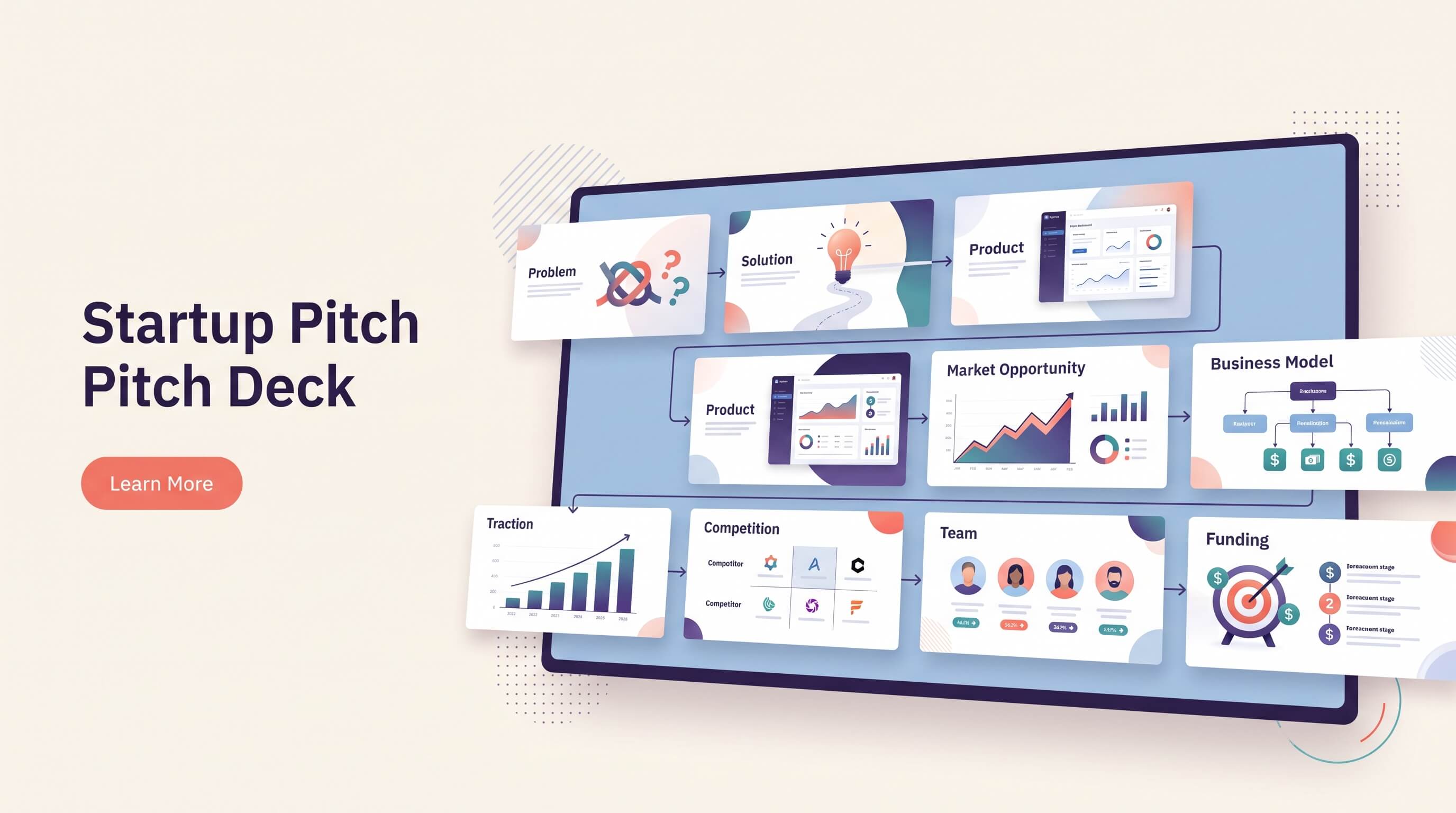
<p>The important thing is to create a logical progression from <strong>problem → solution → opportunity → execution → investment</strong>.</p>
<h2 id="toc-1-start-with-a-strong-cover-slide-1">1. Start With a Strong Cover Slide</h2>
<p>The first slide should immediately tell the audience what your startup does.</p>
<p>Keep it simple.</p>
<p>Your cover slide can include:</p>
<ul>
<li>Startup name</li>
<li>Logo</li>
<li>Short tagline</li>
<li>One-sentence description</li>
<li>Presenter name and contact information</li>
</ul>
<p>Avoid filling the first slide with unnecessary information.</p>
<p>A good pitch deck cover should answer one basic question:</p>
<p><strong>What is this company?</strong></p>
<p>For example:</p>
<blockquote>
<p>AI-powered financial management for small businesses.</p>
</blockquote>
<p>That is much more useful than a vague tagline such as:</p>
<blockquote>
<p>Building the future of finance.</p>
</blockquote>
<p>The first slide establishes the context for everything that follows.</p>
<h2 id="toc-2-define-the-problem-1">2. Define the Problem</h2>
<p>Once the audience understands what your company is, explain the problem you are solving.</p>
<p>A strong problem slide should make the audience understand:</p>
<ul>
<li>Who experiences the problem?</li>
<li>What is the problem?</li>
<li>How frequently does it happen?</li>
<li>Why does it matter?</li>
<li>What happens if the problem is not solved?</li>
</ul>
<p>Avoid describing the problem entirely from the company's perspective.</p>
<p>Instead, focus on the customer's experience.</p>
<p>For example:</p>
<blockquote>
<p>Small businesses lose hours every week manually reconciling invoices, payments, and expenses across multiple platforms.</p>
</blockquote>
<p>A specific problem is easier to understand than a broad statement such as:</p>
<blockquote>
<p>Financial management is complicated.</p>
</blockquote>
<p>If possible, support your problem statement with relevant data, customer research, or a meaningful statistic.</p>
<h2 id="toc-3-present-your-solution-1">3. Present Your Solution</h2>
<p>After establishing the problem, introduce your solution.</p>
<p>This slide should make the connection between the problem and your product obvious.</p>
<p>A simple structure is:</p>
<p><strong>Problem → Solution → Outcome</strong></p>
<p>For example:</p>
<blockquote>
<p>Businesses struggle to reconcile financial data across multiple platforms. Our platform automatically connects transactions, invoices, and expenses into a single financial workspace.</p>
</blockquote>
<p>Keep the explanation concise.</p>
<p>You do not need to explain every feature yet.</p>
<p>The goal of this pitch deck slide is to make the audience understand <strong>how your startup solves the problem</strong>.</p>
<h2 id="toc-4-show-the-product-1">4. Show the Product</h2>
<p>Now show the actual product.</p>
<p>This is where screenshots, product interfaces, workflows, diagrams, or product demonstrations can become extremely useful.</p>
<p>A product slide can include:</p>
<ul>
<li>Product screenshots</li>
<li>Key features</li>
<li>User workflow</li>
<li>Before-and-after comparison</li>
<li>Product architecture</li>
<li>Short demonstration</li>
</ul>
<p>Do not show ten screenshots without context.</p>
<p>Instead, highlight the product experience that directly connects to the problem introduced earlier.</p>
<p>A good product slide should answer:</p>
<p><strong>What does the customer actually use?</strong></p>
<p>If your product is complex, consider splitting this section into two or three slides rather than trying to explain everything on one page.</p>
<h2 id="toc-5-explain-the-market-opportunity-1">5. Explain the Market Opportunity</h2>
<p>Investors need to understand whether the problem represents a meaningful business opportunity.</p>
<p>This is where you introduce the market.</p>
<p>Common metrics include:</p>
<ul>
<li>TAM — Total Addressable Market</li>
<li>SAM — Serviceable Available Market</li>
<li>SOM — Serviceable Obtainable Market</li>
</ul>
<p>However, avoid presenting large market numbers without explaining how they relate to your actual business.</p>
<p>A strong market opportunity slide connects:</p>
<p><strong>Target customer → Market size → Business opportunity</strong></p>
<p>If possible, explain how your market estimate was calculated.</p>
<p>Credible assumptions are more valuable than an impressive but unexplained number.</p>
<h2 id="toc-6-explain-your-business-model-1">6. Explain Your Business Model</h2>
<p>Your audience should understand how the startup makes money.</p>
<p>Depending on your business, this could involve:</p>
<ul>
<li>Subscription</li>
<li>Transaction fees</li>
<li>Marketplace commissions</li>
<li>Licensing</li>
<li>Usage-based pricing</li>
<li>Advertising</li>
<li>Enterprise contracts</li>
<li>Freemium conversion</li>
</ul>
<p>For a SaaS startup, for example, you might show:</p>
<p><strong>Free → Pro → Business → Enterprise</strong></p>
<p>You can also include important metrics such as:</p>
<ul>
<li>Average revenue per customer</li>
<li>Customer acquisition cost</li>
<li>Lifetime value</li>
<li>Gross margin</li>
<li>Monthly recurring revenue</li>
</ul>
<p>The objective is simple:</p>
<p><strong>How does this company turn customers into revenue?</strong></p>
<h2 id="toc-7-show-traction-1">7. Show Traction</h2>
<p>Traction is one of the most important parts of an investor pitch deck.</p>
<p>If you already have customers or users, demonstrate measurable progress.</p>
<p>Potential traction metrics include:</p>
<ul>
<li>Revenue</li>
<li>Monthly recurring revenue</li>
<li>Number of customers</li>
<li>Active users</li>
<li>Growth rate</li>
<li>Retention</li>
<li>Conversion rate</li>
<li>Partnerships</li>
<li>Downloads</li>
<li>Transaction volume</li>
</ul>
<p>Instead of simply writing:</p>
<blockquote>
<p>We have strong growth.</p>
</blockquote>
<p>Show the actual numbers.</p>
<p>For example:</p>
<blockquote>
<p>$120K ARR<br>2,400 paying customers<br>18% month-over-month growth</p>
</blockquote>
<p>Use charts where they help communicate momentum.</p>
<p>If you are pre-revenue, traction can also include:</p>
<ul>
<li>Product development</li>
<li>Beta users</li>
<li>Letters of intent</li>
<li>Pilot customers</li>
<li>Partnerships</li>
<li>Waitlist growth</li>
<li>Customer interviews</li>
<li>Early engagement</li>
</ul>
<p>The key is to show evidence that the startup is moving forward.</p>
<h2 id="toc-8-explain-your-go-to-market-strategy-1">8. Explain Your Go-to-Market Strategy</h2>
<p>A great product does not automatically become a great business.</p>
<p>Your pitch deck should explain how you plan to acquire customers.</p>
<p>Your go-to-market strategy might include:</p>
<ul>
<li>Content marketing</li>
<li>SEO</li>
<li>Paid acquisition</li>
<li>Sales teams</li>
<li>Partnerships</li>
<li>Influencer marketing</li>
<li>Product-led growth</li>
<li>Community</li>
<li>Marketplaces</li>
<li>Referral programs</li>
</ul>
<p>Explain which channels you are using and why they make sense for your target market.</p>
<h2 id="toc-9-analyze-the-competition-1">9. Analyze the Competition</h2>
<p>Every serious startup pitch deck should address the competitive landscape.</p>
<p>Do not claim that you have no competitors.</p>
<p>If customers are currently solving the problem using spreadsheets, manual processes, agencies, or another category of software, those are part of your competitive landscape.</p>
<p>A competition slide can compare your company based on relevant dimensions such as:</p>
<ul>
<li>Price</li>
<li>Ease of use</li>
<li>Automation</li>
<li>Features</li>
<li>Distribution</li>
<li>Target market</li>
<li>Integration</li>
<li>Performance</li>
</ul>
<p>The purpose of the slide is not to make competitors look bad.</p>
<p>It is to explain <strong>why your startup has a credible opportunity to win</strong>.</p>
<h2 id="toc-10-highlight-your-competitive-advantage-1">10. Highlight Your Competitive Advantage</h2>
<p>After showing the competition, explain what makes your startup difficult to replace or replicate.</p>
<p>Your advantage could come from:</p>
<ul>
<li>Proprietary technology</li>
<li>Data</li>
<li>Network effects</li>
<li>Distribution</li>
<li>Brand</li>
<li>Partnerships</li>
<li>Switching costs</li>
<li>Operational expertise</li>
<li>Unique intellectual property</li>
<li>Domain expertise</li>
</ul>
<p>Avoid generic claims such as:</p>
<blockquote>
<p>We have the best technology.</p>
</blockquote>
<p>Instead, explain what creates the advantage.</p>
<h2 id="toc-11-introduce-the-team-1">11. Introduce the Team</h2>
<p>Investors are also investing in the people building the company.</p>
<p>Your team slide should focus on relevant experience.</p>
<p>Include:</p>
<ul>
<li>Founder names</li>
<li>Roles</li>
<li>Relevant experience</li>
<li>Previous companies</li>
<li>Industry expertise</li>
<li>Notable achievements</li>
</ul>
<p>You do not need to include every detail from each person's résumé.</p>
<p>Highlight the experience that supports the company's ability to solve the problem.</p>
<p>The team slide should answer:</p>
<p><strong>Why is this team particularly qualified to build this company?</strong></p>
<h2 id="toc-12-present-the-financials-1">12. Present the Financials</h2>
<p>Depending on your stage and fundraising process, your pitch deck may include financial projections.</p>
<p>A financial slide can show:</p>
<ul>
<li>Revenue</li>
<li>Gross margin</li>
<li>Operating expenses</li>
<li>EBITDA or operating profit</li>
<li>Customer growth</li>
<li>Cash requirements</li>
<li>Projected runway</li>
</ul>
<p>For early-stage startups, avoid presenting overly precise five-year forecasts as if they were guaranteed outcomes.</p>
<p>Instead, focus on the major assumptions behind the model.</p>
<p>Investors are often more interested in understanding <strong>how the business scales</strong> than seeing a perfect-looking spreadsheet.</p>
<h2 id="toc-13-make-the-funding-ask-1">13. Make the Funding Ask</h2>
<p>If the pitch deck is being used to raise capital, clearly state how much funding you are seeking.</p>
<p>For example:</p>
<blockquote>
<p>We are raising $2 million to expand the product, grow the sales team, and enter three additional markets.</p>
</blockquote>
<p>You can also show how the capital will be allocated.</p>
<ul>
<li>45% Product & Engineering</li>
<li>30% Sales & Marketing</li>
<li>15% Operations</li>
<li>10% Administration</li>
</ul>
<p>The funding slide should make the connection between:</p>
<p><strong>Capital → Activities → Milestones</strong></p>
<h2 id="toc-14-end-with-a-clear-closing-slide-1">14. End With a Clear Closing Slide</h2>
<p>Your final slide should bring the story back to the opportunity.</p>
<p>A strong closing slide can include:</p>
<ul>
<li>One-sentence company statement</li>
<li>Key traction metric</li>
<li>Vision</li>
<li>Funding ask</li>
<li>Contact information</li>
</ul>
<p>Do not introduce completely new information on the final slide.</p>
<p>The closing should reinforce what the audience has already learned.</p>
<h2 id="toc-how-many-slides-should-a-startup-pitch-deck-have-1">How Many Slides Should a Startup Pitch Deck Have?</h2>
<p>There is no universal number of slides that works for every startup.</p>
<p>However, a concise investor pitch deck often works well with approximately <strong>10–15 core slides</strong>.</p>
<p>The ideal number depends on:</p>
<ul>
<li>Startup stage</li>
<li>Fundraising stage</li>
<li>Presentation duration</li>
<li>Audience</li>
<li>Business complexity</li>
<li>Amount of supporting evidence</li>
</ul>
<p>A good pitch deck prioritizes <strong>clarity over volume</strong>.</p>
<h2 id="toc-the-ideal-pitch-deck-structure-1">The Ideal Pitch Deck Structure</h2>
<h3 id="toc-1-context-1">1. Context</h3>
<p><strong>Cover → Problem</strong></p>
<p>Explain what the company is and why the problem matters.</p>
<h3 id="toc-2-solution-1">2. Solution</h3>
<p><strong>Solution → Product</strong></p>
<p>Show how the startup solves the problem.</p>
<h3 id="toc-3-opportunity-1">3. Opportunity</h3>
<p><strong>Market → Business Model</strong></p>
<p>Explain how large the opportunity is and how the company makes money.</p>
<h3 id="toc-4-evidence-1">4. Evidence</h3>
<p><strong>Traction → Competition → Advantage</strong></p>
<p>Show why the business has a realistic chance of winning.</p>
<h3 id="toc-5-execution-1">5. Execution</h3>
<p><strong>Go-to-Market → Team → Financials</strong></p>
<p>Explain how the company will scale.</p>
<h3 id="toc-6-investment-1">6. Investment</h3>
<p><strong>Funding Ask → Closing</strong></p>
<p>Explain what you are raising and what the capital will accomplish.</p>
<p>This structure creates a natural narrative instead of treating each slide as an isolated piece of information.</p>
<h2 id="toc-common-startup-pitch-deck-mistakes-1">Common Startup Pitch Deck Mistakes</h2>
<h3 id="toc-too-much-text-1">Too Much Text</h3>
<p>A pitch deck is a visual presentation, not a business plan.</p>
<p>Use short statements, numbers, charts, diagrams, screenshots, and visual hierarchy to make the information easier to understand.</p>
<h3 id="toc-too-many-features-1">Too Many Features</h3>
<p>Your audience does not need to see every feature your product has. Focus on the features that demonstrate your solution to the core problem.</p>
<h3 id="toc-unrealistic-market-numbers-1">Unrealistic Market Numbers</h3>
<p>A large TAM does not automatically mean a large business. Explain your target customer and market assumptions instead.</p>
<h3 id="toc-no-evidence-1">No Evidence</h3>
<p>A compelling story without evidence is still just a story. Whenever possible, support claims with revenue, customer numbers, growth, research, usage data, testimonials, or partnerships.</p>
<h3 id="toc-weak-visual-hierarchy-1">Weak Visual Hierarchy</h3>
<p>Even strong content can become difficult to understand when every element on the slide has the same visual weight.</p>
<p>Each slide should have one obvious takeaway.</p>
<h2 id="toc-how-to-design-better-pitch-deck-slides-1">How to Design Better Pitch Deck Slides</h2>
<p>Good pitch deck design is not about adding more decoration. It is about making important information easier to understand.</p>
<p>Use a consistent visual system across the presentation:</p>
<ul>
<li>One typography system</li>
<li>Consistent spacing</li>
<li>Clear slide titles</li>
<li>Limited color palette</li>
<li>Consistent chart styles</li>
<li>Strong alignment</li>
<li>Predictable layouts</li>
</ul>
<p>Most importantly, establish a visual hierarchy.</p>
<p>The audience should immediately know:</p>
<p><strong>What is the main point?</strong></p>
<p>Then:</p>
<p><strong>What evidence supports it?</strong></p>
<p>Then:</p>
<p><strong>What should I look at next?</strong></p>
<p>A professionally designed pitch deck template can help you establish this structure without designing every slide from scratch.</p>
<p><a href="https://www.appiqa.com/product/pitchdeck">Explore Appiqa Pitch Deck Templates</a> to find presentation layouts that can be customized for startup, investor, and business presentations.</p>
<h2 id="toc-start-with-the-story-then-design-the-slides-1">Start With the Story, Then Design the Slides</h2>
<p>One of the biggest mistakes founders make is opening PowerPoint or Keynote and immediately designing slides.</p>
<p>Start with the story instead.</p>
<p>Write down:</p>
<ol>
<li>What problem are we solving?</li>
<li>Who has this problem?</li>
<li>Why is the problem important?</li>
<li>What is our solution?</li>
<li>Why is our solution better?</li>
<li>How large is the opportunity?</li>
<li>How do we make money?</li>
<li>What evidence do we have?</li>
<li>Why can we win?</li>
<li>What do we need from investors?</li>
</ol>
<p>Once these questions are answered, turn each answer into a slide.</p>
<p>This makes the presentation much easier to structure.</p>
<h2 id="toc-startup-pitch-deck-checklist-1">Startup Pitch Deck Checklist</h2>
<ul>
<li>Is the startup immediately understandable?</li>
<li>Is the problem specific?</li>
<li>Is the solution clear?</li>
<li>Can the product be understood quickly?</li>
<li>Is the market opportunity credible?</li>
<li>Is the business model clear?</li>
<li>Is there measurable traction?</li>
<li>Is the go-to-market strategy realistic?</li>
<li>Are the competitors acknowledged?</li>
<li>Is the competitive advantage clear?</li>
<li>Does the team have relevant expertise?</li>
<li>Are the financial assumptions understandable?</li>
<li>Is the funding ask specific?</li>
<li>Does every slide have one clear message?</li>
<li>Is the deck visually consistent?</li>
</ul>
<h2 id="toc-final-thoughts-1">Final Thoughts</h2>
<p>Creating a startup pitch deck from zero does not require dozens of slides or complicated storytelling.</p>
<p>The most effective pitch decks usually follow a simple principle:</p>
<p><strong>Start with the problem, demonstrate the solution, prove the opportunity, show evidence, and explain why your team can win.</strong></p>
<p>Use the <strong>startup pitch deck outline</strong> as a starting point, then adapt the number and order of slides to your startup, audience, and fundraising stage.</p>
<p>Your pitch deck should not try to answer every possible question.</p>
<p>Its job is to create enough clarity, credibility, and interest to start the next conversation.</p>
<p>If you are looking for a faster way to build a professional investor presentation, <a href="https://www.appiqa.com/product/pitchdeck">explore Appiqa's pitch deck templates</a> for ready-to-customize presentation layouts designed for startup and business presentations.</p>
Recommended Architecture
Explore all